
Mold Removal Services in Middle Georgia
Mold on a floor joist, subfloor, or foundation wall spreads through the wood and into the air your family breathes every day. Homeowners in Macon and Warner Robins often notice a musty smell that won’t go away, or discoloration on wood and drywall that keeps returning no matter how many times it’s cleaned. Left alone, it damages the structure it grows on and can contribute to allergy symptoms and respiratory irritation for anyone in the home. Mold remediation addresses both problems at once, removing what’s already growing and correcting the conditions that let it take hold.
Stapleton Foundation Systems is a mold remediation company that removes mold at the source and corrects the moisture problem behind it. We also install basement and crawl space dehumidifiers since treating visible mold without fixing the humidity or water intrusion means it comes back within a season. A free inspection is the first step toward finding out how much of your crawl space or basement is affected and what it will take to fix it.

Contact Middle Georgia’s Local Mold Experts
Why Mold Is a Problem in Middle Georgia
Middle Georgia sits in a humid subtropical climate, and the region gets roughly 45.7 inches of rain a year. That rain saturates the soil around a home’s foundation, and crawl spaces and basements sit closest to that moisture. Warm temperatures stretch from late March through early November, giving mold spores months of the exact conditions they need to grow: consistent humidity and stable heat. A crawl space without a vapor barrier or proper sealing pulls that ground moisture straight into the air underneath the house.
Wood framing, subfloors, and insulation all hold onto moisture longer than concrete or drywall, which is why mold tends to establish itself on floor joists and support beams first. Once spores land on a damp wood surface, they don’t need much time to start colonizing it. A crawl space that stays humid through the summer gives mold a steady environment to keep spreading, even in areas of the home that never flood or take on standing water. That’s the part homeowners often miss: mold growth doesn’t require a leak, just persistent dampness.
Signs Your Basement or Crawl Space has mold
Some signs of mold are obvious the moment you open a crawl space hatch or basement door. Others show up gradually, in ways that are easy to explain away until they’ve been going on for months. Here’s what to look for.
A Damp Crawl Space or Basement
If the ground under your home stays wet or the air feels heavy and cool even on a dry day, moisture is already doing its work. Standing water isn’t necessary. A crawl space with exposed dirt or a basement without proper drainage can hold enough humidity to keep mold fed for weeks at a time. Touch the floor joists or foundation walls. If they feel damp or cool to the touch, that’s worth a closer look.
Discoloration on Drywall or Wood Framing
Dark spots, staining, or a fuzzy texture on drywall, subfloors, or floor joists are common places mold shows up first. Greenish-black or dark charcoal staining in particular can be a sign of black mold, one of the more serious varieties homeowners watch for. It often starts small, in a corner or along a seam, and spreads outward if it isn’t addressed. Paint or wallpaper won’t stop it. Whatever is growing underneath will keep working through the surface.
A Musty or Earthy Smell
A smell that lingers near the basement stairs or crawl space access, even after cleaning, is one of the most reliable indicators of hidden mold. It’s often stronger in humid weather and fades slightly in dry spells, but it doesn’t go away on its own. If you’ve noticed the smell drifting up into living spaces above the crawl space, that’s a sign the problem has been there for a while.
Allergy or Respiratory Symptoms at Home
Sneezing, itchy eyes, or a scratchy throat that shows up indoors and eases once you leave the house can point to mold spores in the air. These symptoms are easy to attribute to seasonal allergies, but if they track with time spent in specific rooms, particularly those above a crawl space or basement, it’s worth having the space inspected.
Dirty Air Filters or Irritation When the HVAC Runs
Mold spores travel through ductwork, and a crawl space or basement growing mold feeds those spores straight into your HVAC system. Air filters that need replacing more often than usual can point to a mold source pulling contaminated air into the system. A musty smell specifically when the heat or air conditioning kicks on, or sneezing and eye irritation right as the system starts, both point to the same source.
DON’T IGNORE THE SIGNS
Catching mold issues early can save you from expensive repairs and protect your home’s value. If you notice any of these signs, schedule a free inspection with Stapleton Foundation Systems today.
How Stapleton Removes Mold
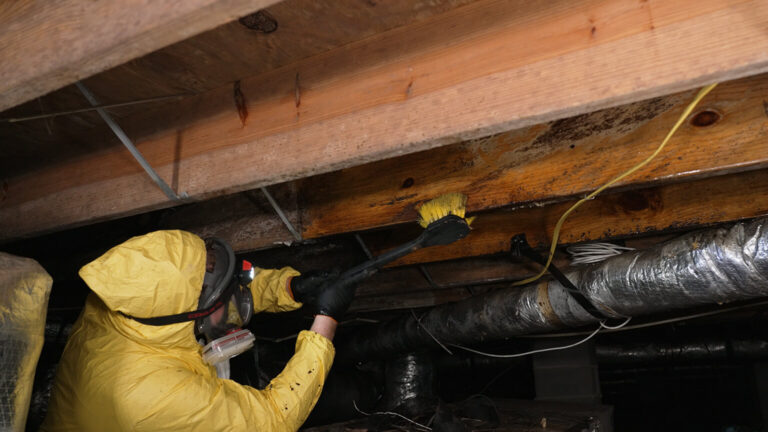
Every job starts with an inspection to find where moisture is entering the crawl space or basement and how far the mold has spread. Technicians check floor joists, subfloor, insulation, and foundation walls, since mold often extends further than what’s visible from the access point. That assessment determines the scope of the job and what containment will be needed before any work begins.
Affected areas are sealed off during removal to keep spores from spreading into the rest of the home. Air filtration devices run throughout the process to manage airborne particles, and Dilute Oxidation Technology treats the affected surfaces directly, breaking down mold at the source with less reliance on harsh chemicals. Wood framing and subfloor are cleaned and treated rather than replaced wherever the structure allows it, which keeps costs down and avoids unnecessary demolition.
If the inspection turns up a persistent humidity problem, a HumidiGuard dehumidifier and air filtration system is available to keep the space dry year-round so the mold doesn’t come back. It’s not part of every job. Some crawl spaces and basements just need better sealing or drainage to stay dry; others, especially ones that stay damp through the summer, benefit from ongoing humidity control. Your technician will tell you which situation you’re in and why.
Stapleton Foundation Systems has spent nearly three decades on mold remediation and moisture control throughout Middle Georgia. Technicians trace moisture back to its source, check framing and insulation that sits out of view, and confirm the problem is fully resolved before calling a job finished. As a mold removal company working across Macon and the surrounding region, Stapleton treats every inspection as a chance to catch what a surface-level check would miss.
Every inspection is free, and homeowners get a clear explanation of what’s causing the mold and what it will take to fix it before any work begins. Stapleton backs its mold remediation work with a warranty, so the investment in fixing the problem stays protected long after the crew leaves.

Schedule Your Mold Remediation Inspection Today
Mold in a crawl space or basement affects both your home and your health the longer it sits untreated. Stapleton Foundation Systems will inspect the affected area, walk you through what’s causing it, and lay out a clear plan to remove it for good. Every inspection is free, with no pressure to move forward until you’ve seen exactly what you’re dealing with.
Schedule your free inspection and a member of our Stapleton team will follow up to get you on the schedule.
