
Protecting Your Home’s Integrity, One Foundation at a Time
Foundation Repair
Cracks spreading across bricks, sloping floors, doors refusing to close — these are signs that the ground beneath your home is shifting and the structure is moving with it. If left unchecked, foundation damage can worsen with time. Stapleton Foundations stabilizes homes throughout Middle Georgia. Whether it’s expansive clay or hydrostatic pressure, trust us to address the root cause and restore your foundation’s stability.

Contact Middle Georgia’s Local Foundation Repair Experts
Understand Middle Georgia's Unique Soil Challenges
Parts of Middle Georgia sit along and around the Fall Line, a geological boundary that separates the Piedmont from the Coastal Plain. Around this boundary, soil conditions can vary from one property to the next. Areas north of the boundary have clay-heavy soils that expand when wet and shrink when dry. Others, like Warner Robins and Houston County, have sandier soils that drain differently and may settle over time.
Because of these differences, foundation damage can look similar across the region even when the cause is different. Cracks, settling, bowing walls, sticking doors and uneven floors may all point to movement below your home, but the right repair depends on what is happening at your property. That’s why Stapleton Foundations starts with a thorough inspection before recommending a solution. Then, we build a customized repair plan designed for your home, your foundation and the soil conditions beneath it.
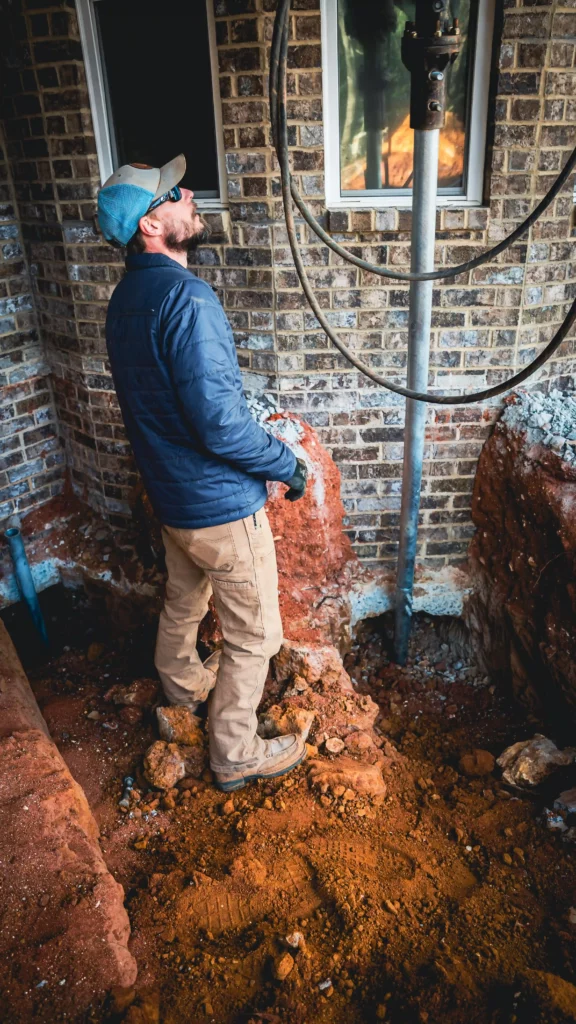
Recognize the Warning Signs
Foundation damage escalates quickly. Recognizing these signs early helps catch problems before they require costly repairs:
Stair-step cracks in brick or block
Diagonal cracks following mortar joints can signal foundation movement and may continue to widen without repair.
Cracks in drywall
New or widening cracks around doors, windows, or corners can point to shifting below your home.
Bowing basement walls
Walls curving inward indicate excessive soil pressure and need reinforcement before they fail.
Sagging or bouncy floors
Floors that dip or flex mean the support underneath has settled unevenly.
Doors and windows that jam
Frames shift out of square when foundations move, causing them to bind.
Gaps opening between walls and ceilings
Visible separation means part of the house could be sinking.
DON’T IGNORE THE SIGNS
If you see these signs, schedule a professional inspection. Foundation movement doesn’t self-correct — ignoring it may lead to more expensive problems.
What Causes Foundation Problems in Middle Georgia Homes?
The primary cause depends on where your home sits relative to Georgia’s Fall Line. In Macon and the Piedmont side of the county, Cecil series clay swells when it absorbs rainwater and shrinks again during dry stretches, and that repeated cycle puts pressure on a foundation that eventually shows up as a crack or a section of settling. In Warner Robins and the Coastal Plain side, the soil holds less water on its own, but the water table sits close enough to the surface that hydrostatic pressure pushes against a foundation wall or slab instead, especially after heavy rain feeds into the Ocmulgee River basin.
Other Common Causes of Foundation Issues
A few other conditions make either problem worse, layered on top of the soil and water table itself.
- Drainage that doesn’t move water away from the foundation, letting it pool against the same section of wall repeatedly
- Grading that slopes toward the house instead of away from it, directing runoff straight at the foundation
- Extended drought that dries out expansive clay faster than normal, causing it to shrink more than it would in a typical season
- Original construction with inadequate soil compaction or undersized footings, which shows up years later as uneven settling
- Years of cumulative movement wearing down materials that were sound when the home was first built
Each of these can speed up movement that started with the soil or water table underneath the house. Our inspection identifies which ones apply to your home before we recommend a repair.

Other Common Causes of Foundation Issues
- Poor or inadequate drainage systems around your home’s perimeter.
- Improper grading of the ground, directing water toward the foundation instead of away.
- Extended drought conditions that cause severe soil shrinkage.
- Inadequate soil compaction before construction, or poorly designed footings.
- The natural aging process or original construction flaws in older foundations.
Get Customized Foundation
Repair in Middle Georgia
An inspection can help determine whether your home needs foundation settlement repair, wall reinforcement, foundation crack repair or another customized solution. At Stapleton Foundations, we manufacture our own proprietary systems instead of relying on generic products. Our approach to foundation crack repair involves sealing cracks and reinforcing compromised walls when needed. For settlement, we use specialized systems designed to lift and stabilize sinking foundations for long-term support.
STEEL PUSH PIERS
Steel piers are driven through the soil until they reach load-bearing rock or dense, stable soil far below the surface, well past the expansive clay or shifting sand causing the problem. Once in place, they lift the foundation back toward its original position and hold it there permanently, since the piers are bearing weight from a depth the surface soil can’t affect.
HELICAL PIERS
Helical piers provide the solution for stabilizing a settling foundation. We install helical piers and push piers below unstable surface soil to reach stronger, load-bearing ground, transferring your home’s weight onto stable support. These steel piers halt further settlement and can also lift the foundation back to its original position. Our team is highly trained in installing these specific systems with minimal disruption to your property.
SLAB PIER SYSTEMS
Homes built on a concrete slab need a different approach than a home with a crawl space, since there’s no accessible foundation wall to work from. Slab piers are installed through the concrete itself at the specific points where the slab has sunk, then used to raise that section back to level before the hole is sealed.
CRAWL SPACE SUPPORT JACKS
Adjustable jacks go under sagging floor joists in a crawl space, lifting the floor back to level and holding it there with steel posts rated for the load. This addresses sagging that started in the crawl space itself, common in older homes where the original support posts were undersized or have deteriorated over time.
WALL ANCHORS & CARBON
FIBER REINFORCEMENT
A bowing basement or crawl space wall gets pulled back into place using anchors set in the yard beyond the failure zone, connected through the wall with a steel rod that can be tightened over time. Carbon fiber strips serve a different purpose, reinforcing a wall that’s cracked but hasn’t bowed significantly, stopping further movement without the excavation a wall anchor system requires.
It’s important to know that we never use a one-size-fits-all approach. Every home receives a detailed,
customized repair plan based on a thorough inspection of its specific issues and conditions.

Headquartered in Juliette, Stapleton Foundations understands exactly how local weather and soil impact homes in the area. Our zero-pressure approach means every foundation repair project starts with a thorough inspection, resulting in a transparent, custom repair plan. We offer an extensive warranty and flexible financing options to make protecting your investment affordable.
HOW THE PROCESS WORKS
Choosing Stapleton means choosing peace of mind. Here’s how we take care of each of our customers:
Book a convenient time for our experts to assess your foundation and answer your questions.
We’ll explain exactly what’s happening and provide a detailed, no-obligation repair plan.
From permits to cleanup, our team manages every step so you don’t have to worry.
Enjoy a safer, more stable home, backed by our trusted warranties and ongoing support.
Ask The Experts!
Q: What are the signs that my foundation needs repair?
Common indicators include cracks in walls or ceilings, uneven or sloping floors, sticking doors or windows, and gaps around door or window frames.
Q: Can foundation repairs be done during winter?
Yes, most foundation repairs can be performed year-round.
Experienced contractors have the tools and materials to work even when the ground is frozen.
Q: How long does a typical foundation repair take?
The duration varies based on the repair’s complexity, but many foundation repairs can be completed in just one day.
Q: How do I know which type of foundation repair my home needs?
That’s where our local expertise comes in. Every Macon home is different: soil conditions, foundation type (slab vs. crawl space), and damage severity all factor into the repair approach. During our free inspection, we assess signs of foundation damage such as sloping floors, gaps around windows, stair-step cracks in bricks, or sagging crawl spaces. Based on this evaluation, we’ll recommend the most effective foundation repair solution, from pier systems and wall anchors to full crawl space encapsulation.
Q: Is foundation damage common in Macon, GA?
Yes. Foundation problems are especially common in Macon due to our region’s expansive clay soil, high humidity, and seasonal rain patterns. These conditions can cause the ground to shift dramatically, leading to foundation settlement, slab cracks, bowing walls, and crawl space moisture issues. Homes in Macon built on older or improperly compacted soil are particularly vulnerable. That’s why regular inspections and early detection are key to protecting your property.
Q: What happens if I ignore foundation problems?
Delaying foundation repair can significantly worsen your home’s structural issues. Cracks in your foundation walls or floors can expand, doors and windows may stop functioning properly, and moisture can infiltrate your crawl space. This can lead to mold, wood rot, and air quality issues. In extreme cases, neglecting a settling or sinking foundation can compromise the structural integrity of your entire home. Investing in timely repairs not only protects your property value, but also prevents more expensive damage down the road.
How Much Does Foundation Repair Cost in Middle Georgia?
The cost of foundation repair depends on the severity of the issue, the type of repair needed, and the condition of your soil.
Minor foundation crack repairs may be more affordable, while structural solutions like piers require a larger investment.
The best way to get an accurate estimate is through a professional inspection.
Q: Will foundation repair disrupt my daily life?
We understand that home repairs can be stressful. At Stapleton Foundation Systems, we minimize disruption by using efficient, non-invasive methods like crawl space jacks, helical piers, and polyurethane injections when appropriate. Most foundation repairs are completed in 1–3 days depending on the severity of the issue. Our crew respects your time and property. We’ll keep the jobsite clean, communicate clearly, and ensure a smooth experience from start to finish.
Schedule Your Free Homeowner Inspection
If you own a home and need foundation repair, call our team at 478-309-8158 or fill out the online form to schedule your free inspection.
